
Why a SaaS platform like Rezilio has become essential for the security of smart cities and regions
Cities are evolving rapidly. They are becoming more connected, more digital, and more dependent on complex infrastructure that supports essential services: drinking water, energy, transportation, telecommunications, healthcare, public safety, and municipal services.
This transformation opens up new possibilities, but it also increases the vulnerability of these regions. An IT outage, a cyberattack, an extreme weather event, an infrastructure failure, or an industrial accident can now trigger a chain reaction that extends far beyond the boundaries of a single municipal service.
In this context, ensuring the security of a smart city is no longer just about responding effectively when a crisis strikes. Above all, it is about being able to anticipate, coordinate, share information, and maintain a common understanding of the situation.
This is precisely where next-generation SaaS platforms come into their own.
The Limitations of Traditional Tools
In many organizations, essential information remains scattered across multiple systems, documents, and teams. Emergency plans, contact lists, resource inventories, maps, procedures, and reports are often managed independently of one another.
This fragmentation complicates coordination when every minute counts.
Teams end up spending valuable time searching for information, verifying whether it’s up to date, or passing it between different stakeholders — rather than making decisions.
As territories become more complex, this approach quickly reaches its limits.
A Platform Rather Than a Collection of Applications
True progress lies not in adding new specialized software, but in creating a platform capable of connecting all the information needed to manage a territory.
A modern SaaS platform serves as a shared digital environment where data, processes, and teams converge.
In particular, it enables the centralization of:
- civil protection and business continuity plans;
- human, material, and operational resources;
- contact information for partners and stakeholders;
- ongoing events;
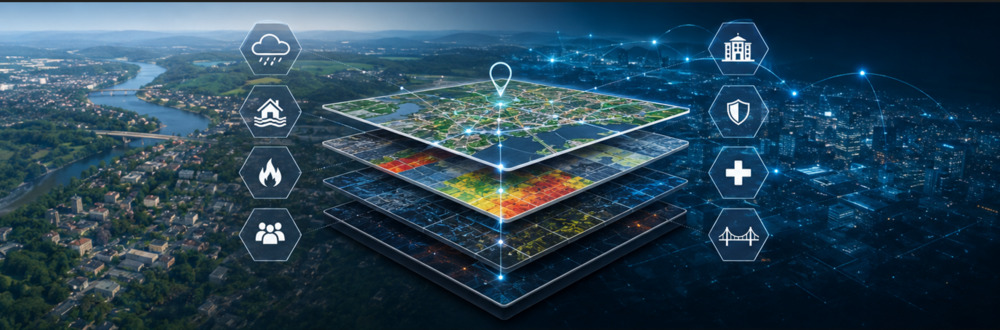
- maps and geospatial data;
- risk analyses;
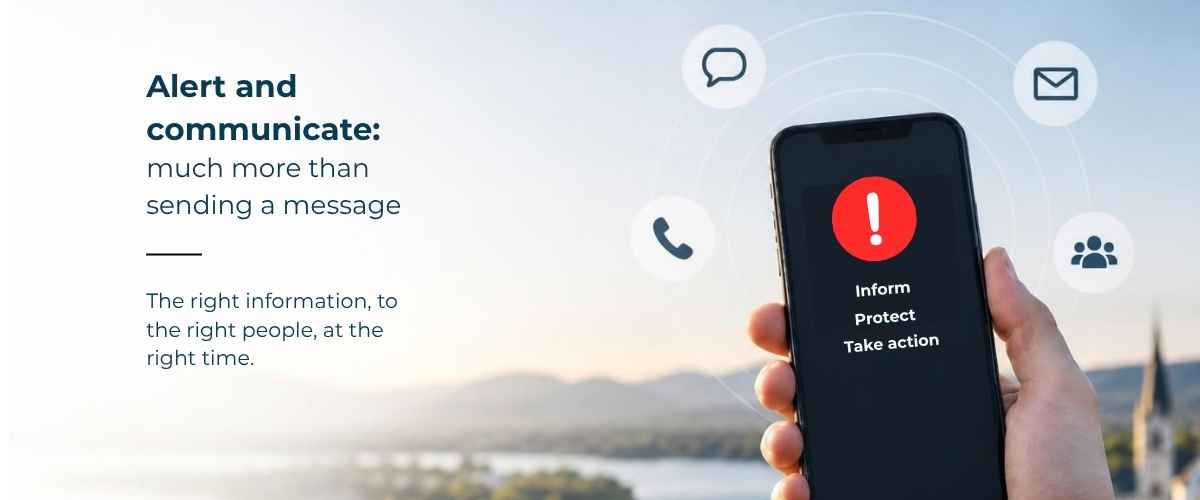
- emergency communications;
- decision-making dashboards.
Each piece of information complements the others and helps build a comprehensive understanding of the situation.
A Shared View for Faster Decisions
During an emergency, the quality of decisions depends directly on the quality of the available information.
Decision-makers must share a common understanding of the situation, often referred to as the Common Operating Picture.
A SaaS platform enables all stakeholders to simultaneously access consistent information that is updated in real time and tailored to their roles.
This capability reduces coordination delays, minimizes the risk of errors, and facilitates communication between municipal departments, public safety organizations, regional partners, and government authorities.
A Community That Learns From Every Event
One of the main advantages of a digital platform lies in its ability to preserve an organization’s operational memory.
Every response, every exercise, every lesson learned, and every decision gradually enriches a knowledge base that can then be reused during future events.
This organizational memory enables continuous improvement of plans, procedures, and practices.
The region thus becomes more resilient with each new experience.
Artificial Intelligence Is Changing the Way Data Is Used
Organizations today have access to a vast amount of information. Yet this data often remains underutilized.
Artificial intelligence now makes it possible to transform this information into useful knowledge.
It can assist teams by quickly summarizing a situation, retrieving relevant information, highlighting vulnerabilities, proposing scenarios, generating reports, or identifying links between different events.
The goal is not to replace human expertise, but to enable decision-makers to devote more time to analysis, coordination, and decision-making.
A Scalable Platform for Regions in Constant Transformation
Unlike applications developed to address a one-time need, a SaaS platform is constantly evolving.
New features, security updates, technological improvements, and integration capabilities can be deployed quickly, without disrupting operations.
This approach offers municipalities and organizations responsible for public safety a sustainable solution capable of keeping pace with evolving risks, standards, technologies, and citizen expectations.
It also promotes interoperability with other systems such as geospatial platforms, emergency coordination centers, notification tools, document management systems, and data analytics solutions.
A Digital Foundation for Resilient Cities
The concept of a smart city is not based solely on the use of sensors, connected devices, or real-time data. Above all, it relies on the ability to transform this information into informed decisions.
A SaaS platform dedicated to public safety, civil protection, risk management, and business continuity now constitutes a true digital infrastructure for resilience.
It connects people, data, processes, and technologies within a single environment to foster proactive rather than reactive management.
As regions become more connected and risks multiply, platforms like Rezilio are no longer merely a technological advancement. They are becoming a strategic tool that enables cities and organizations to better protect their citizens, infrastructure, and essential services, while strengthening their ability to meet the challenges of tomorrow.